 WhatsApp
 LINE

 KakaoTalk


Skin boosters
PRP, PRF and PDRN: What They Are — and What They Aren’t (2026)
By Dr. IM JUNHYUNG · Updated
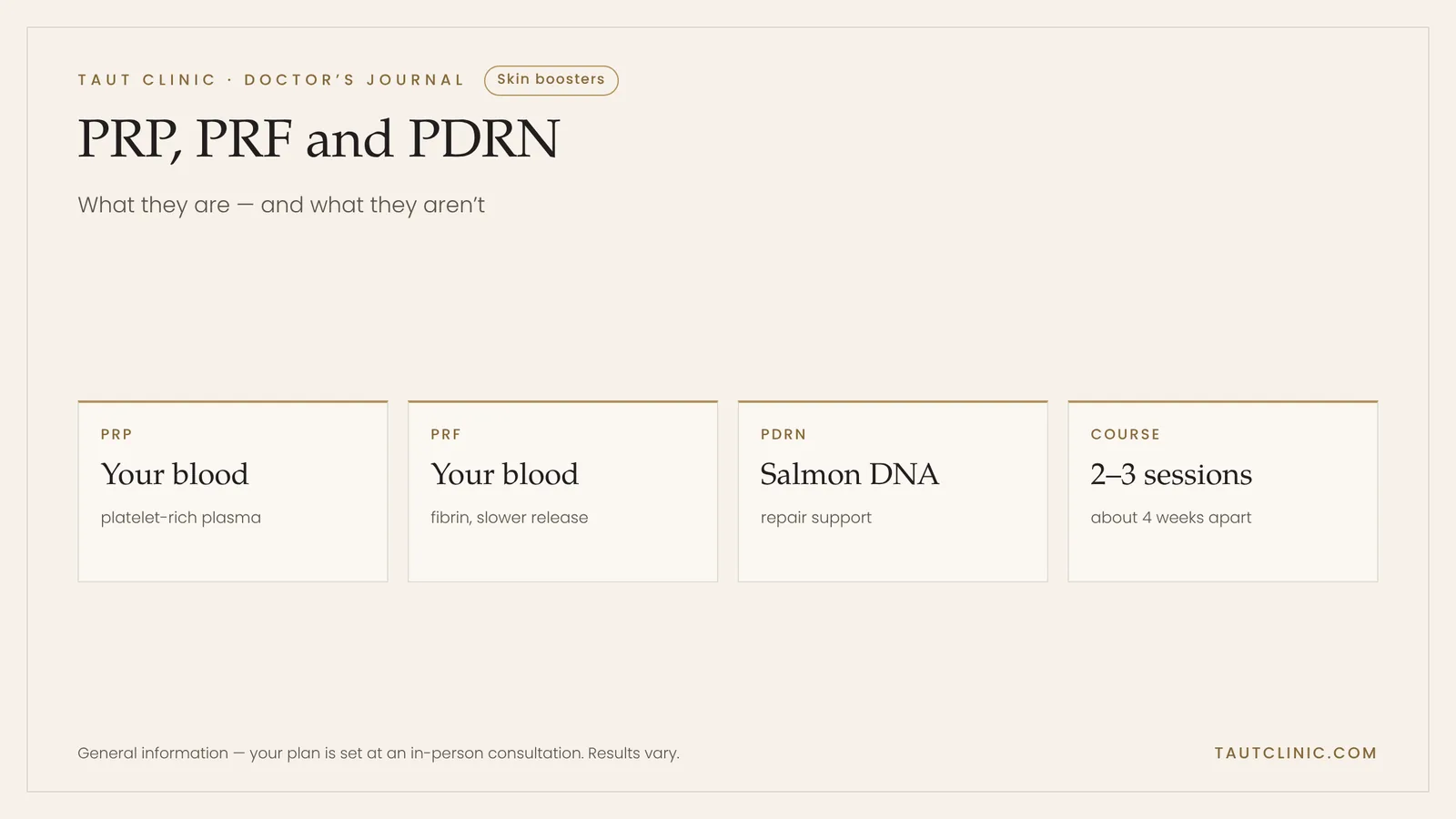
- PRP: blood is spun to concentrate platelets and growth factors.
- PRF: spun without anticoagulant; forms a gel that releases factors more slowly.
- PDRN: salmon-derived DNA fragments that support repair.
- Usually two or three sessions, about four weeks apart; small marks for a day or two.
- PRP
- Your blood — platelet-rich plasma
- PRF
- Your blood — fibrin, slower release
- PDRN
- Salmon DNA — repair support
- Course
- 2–3 sessions — about 4 weeks apart
PRP — from your own blood
We draw a small amount of blood and spin it in a centrifuge to concentrate the platelets. Platelets release growth factors that play a part in healing. Injected into the skin, PRP supports texture, fine lines and recovery — which is why we pair it with Potenza in K-Glass and add it to lifting plans.
PRF — a slower version
PRF is prepared without anticoagulant and spun more gently, so it forms a fibrin gel that holds platelets and white cells and releases factors more slowly. It is often used under the eyes and for skin that needs gentler support.
PDRN — salmon DNA fragments
PDRN (polydeoxyribonucleotide) is a purified DNA fragment derived from salmon. It is thought to support tissue repair and a calmer skin environment. Rejuran uses a related ingredient, polynucleotides (PN), in a different formulation.
Comparing them
| PRP | PRF | PDRN | |
|---|---|---|---|
| Source | Your blood | Your blood | Salmon DNA |
| Blood draw | Yes | Yes | No |
| Feel | Liquid | Gel-like | Liquid |
| Typical course | 2–3 sessions | 2–3 sessions | Regular top-ups |
On a short trip
PRP and PRF need a small blood draw and about 40–60 minutes in total, including numbing; marks fade in one to two days. PDRN is quicker — about 15–20 minutes — with marks for about a day.
All three build over sessions — PRP and PRF two or three, about four weeks apart; PDRN regularly, every two to four weeks — so on a single trip, think of them as a start, or as an add-on to lifting. If you visit Seoul a few times a year, PRP or PRF can be timed to each visit, and the volume used each time goes on your record.
What they aren’t
They are not fillers and won’t add shape. They don’t turn back time in one session. Results are gradual and vary. We describe them as what they are — your own blood concentrate, or a purified DNA fragment — rather than with bigger names.
FAQ
Is PRP painful?
There is a blood draw and small injections after numbing cream; we rate it 2 out of 5.
How many PRP sessions?
Usually two or three, about four weeks apart.
PRP or Rejuran?
PRP comes from your blood; Rejuran is a salmon-derived PN booster. Both support skin quality; we choose by skin and plan.
Who should avoid PRP?
People with certain blood disorders or on blood thinners need planning; we postpone with infection or in pregnancy.
General information, not medical advice. Your plan is set at an in-person consultation; results vary by individual.
Representative Director of Taut Clinic, Gangnam. Full member of the Korean Aesthetic Surgery & Laser Society (ASLS), the Korean Association for Laser Dermatology and Trichology (KALDAT) and the Korean Society of Filler Medicine. Commendation from the Minister of Health and Welfare.
Treatments in this article
See how each treatment mentioned here is done at Taut Clinic, with options and prices.
Ask the doctor directly. No pressure, no same-day decision.
Related reading
Ask the doctor directly.
If something isn’t right for you, we’ll say so. No same-day decision required.